Start Here
Inside the Chip: From Product to Transistor
A short reference for the layers inside a digital product, from the device you hold down to the transistors that build its logic gates.
2 min read · Updated
Every digital product — a phone, a game controller, a medical monitor — is built from one or more chips. Trace the hardware inside one far enough and you pass through several distinct layers, each one built from the layer below it.
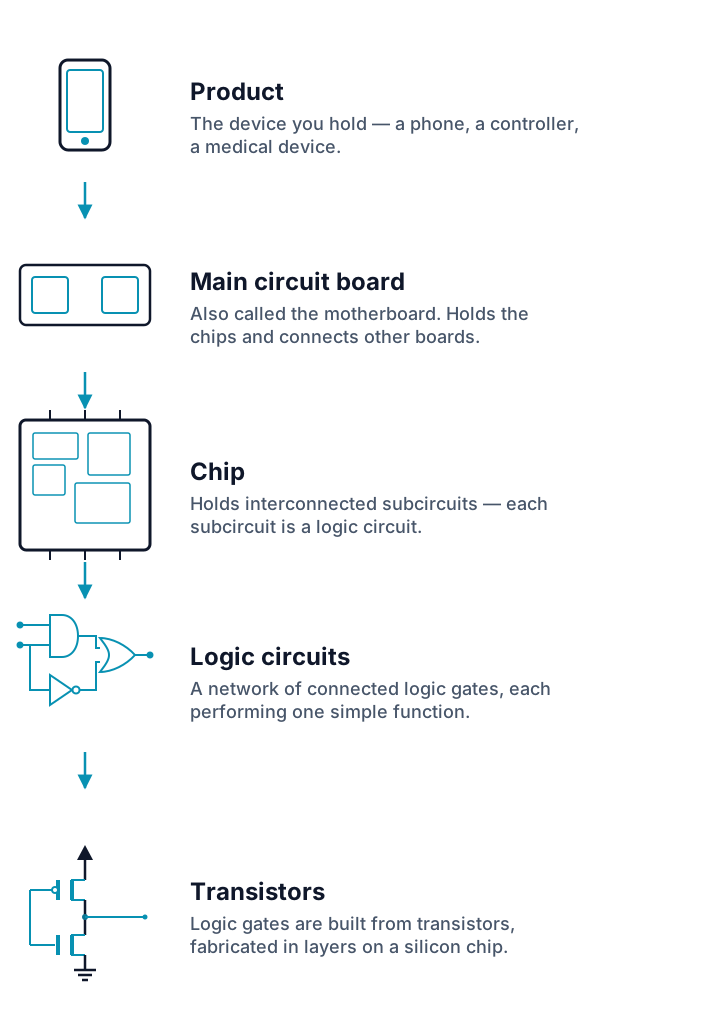
The product's case houses one or more printed circuit boards and a power supply. The main board — the motherboard — holds several integrated-circuit chips and provides slots for other boards, such as audio, video, or network cards. Each chip comprises a number of interconnected subcircuits: blocks that perform arithmetic, store data, or control the flow of data. Every one of those subcircuits is a logic circuit — a network with named inputs and outputs that follows defined rules. Zoom in further and a logic circuit turns out to be a network of connected logic gates, each one a small element that performs one simple function. Logic gates, in turn, are built from transistors, fabricated by layering materials onto a silicon chip.
This course works at the logic-circuit layer — the layer in the middle of that chain. You will not draw transistors or lay out silicon; you will describe what a circuit's gates should compute and confirm that the description behaves correctly. That is where digital design starts, and the reasoning is portable: the same skills apply whether the circuit eventually ships as a custom chip or runs on an FPGA.
Keeping this picture in mind helps later lessons make sense. When you write a module that turns inputs into outputs, you are specifying one logic circuit in that chain — one a synthesis tool can turn into gates, and gates it can turn into transistors on real hardware.